


Autism and ADHD
A service of mse Pharmazeutika GmbH

What are autism and ADHD?
Autism is a genetically determined developmental disorder that becomes apparent before the age of 3 and is characterised by extreme "withdrawal" from the environment and by restricted, repetitive patterns of behaviour. Further symptoms are:
• no sense of dangerous situations
• low tolerance of frustration
• severely restricted perception of the surroundings
• sleep disturbances (waking very early)
• avoidance of eye and physical contact
• problems with the intestinal flora and intestinal mucosa
• withdrawal from the environment; no playing with other children
ADHD is a mental disorder that begins in childhood. Symptoms are inattention, impulsive behaviour and sometimes also hyperactivity. The degree varies. Sometimes hyperactivity is in the foreground, as with the fidgety child, sometimes inattention, as with the daydreamer.
The causes of autism and ADHD
In addition to possible genetic causes, there can be problems with the gut or with intestinal function. For example, increased amounts of zinc and vitamin B6 can be excreted in the urine and thus lost to the body. The incomplete digestion of milk and/or cereal products produces harmful breakdown products that place a heavy burden on the body. Sweeteners, flavour enhancers, preservatives and other additives in food place an additional burden on the organism.
Consequences of autism and ADHD
One of the main consequences of autism and ADHD is physical stress.
This can lead to ...
• an increased release of hormones (affecting almost all organs)
• an increased energy turnover
• inflammatory processes
• a burden on the immune system
• increased formation of free radicals
. Under stress the requirement for micronutrients such as Q10, vitamins, minerals and trace elements is increased.
Mitochondria, autism and ADHD
The provision of energy for all metabolic processes in our organism takes place for the most part via the respiratory chain in the mitochondria ("power plants of the cells"). Depending on their function and their energy requirement, the cells of our body contain up to 1,600 mitochondria.
MitoMedicine with autism and ADHD
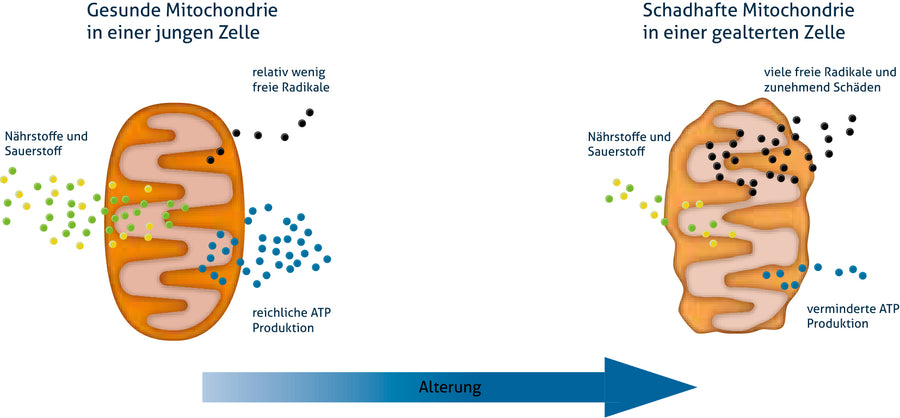
The bioenergetic state, and thus the performance and survival of a cell, depends on the number of intact mitochondria and on how well they are supplied with macronutrients and micronutrients. When about 40% of the mitochondria are damaged, the first symptoms of an energy deficiency appear. If the degree of damage rises further, the typical symptoms of chronic diseases manifest themselves.
The causes and consequences of autism and ADHD mentioned above (above all oxidative and nitrosative stress, mental stress, chronic inflammation, infections as well as a lack of vitamins, minerals and trace elements) can lead to damage to the mitochondria. Energy production is disturbed. The activities in complexes I, II and III of the mitochondrial respiratory chain in particular are noticeably reduced.
Preventive and treatment measures
The treatment of autism and ADHD is individual. The following measures and therapies can be used successfully:
• a gluten-free and casein-free diet
• optimising the energy and micronutrient balance
• regular physical activity in reasonable measure
• a healthy diet with foods free of preservatives and flavour enhancers, among other things
• detoxification, where there is an increased burden of heavy metals
• behavioural therapy
• orthopaedic treatment, for example with a tilted head position
People with autism and ADHD need professional help. An interdisciplinary approach, that is cooperation between different specialties, should be considered with these complex conditions.
The relevant mitotropic substances
A large number of what are known as mitotropic substances (see the consumer information on mitotropic substances) contribute directly and indirectly to maintaining the natural function of the mitochondria and to protecting them. These substances, mostly native to the body, generally play central roles in mitochondrial metabolism and are essential for many metabolic reactions. Avoiding, or compensating for, deficiencies of these substances can contribute to maintaining particularly energy-intensive bodily functions. The following briefly explains the relevant mitotropic substances for the treatment and prevention of autism and ADHD.
Ubiquinol / ubiquinone Q10
Q10 occurs in all cells of our organism. It is a key substance for energy production in the mitochondria and is vital for the entire organism. Coenzyme Q10 is the only lipophilic (fat-soluble) antioxidant produced by the body itself and plays an essential part in protecting the cells from free radicals. As free radicals are formed in particular during energy production in the mitochondria, the Q10 within them contributes not only significantly to the energy supply but also to the protection of the mitochondria. Coenzyme Q10 also fulfils further important functions. It keeps the cell membranes fluid and functional and is involved in the exchange of substances and information between the cells.
Q10 is barely metabolised in the body and is excreted intact in the stool. An external supply therefore places no additional burden on the liver or kidneys. The product range of mse Pharmazeutika GmbH includes numerous Q10 products with individual advantages. We will gladly advise you on which product is the right one for you.
Vitamin B3 - niacinamide
Niacinamide, like Q10, occurs in all cells of our organism. As a coenzyme building block of nicotinamide adenine dinucleotide (NAD) and nicotinamide adenine dinucleotide phosphate (NADP) it is involved in numerous enzymatic reactions of the metabolism and plays a significant part in energy production in the mitochondria. Its function is, among other things, closely linked to ubiquinol/ubiquinone Q10. It also plays a role in the defence against reactive free radicals and takes part in the regeneration of Q10 into its active form.
The mse product TriaMit-B® contains vitamin B3 as niacinamide and can be used to compensate for a bioenergetic deficit in the body. RiboMit® contains vitamin B2 and ubiquinol Q10 in addition to vitamin B3.
Vitamin B12 - cobalamin
Vitamin B12, like Q10, vitamin B2 and vitamin B3, occurs in all cells of our organism. It has a wide range of functions in the body, for example in protein, carbohydrate and fat metabolism, in cell division and in the formation of genetic information. Vitamin B12 plays a particularly important role in the defence against nitrosative stress, which is characterised by excessive amounts of nitric oxide (NO) in the body. Vitamin B12 is one of the most significant counterparts of NO, because it is able to bind and thus neutralise surplus NO as well as the far more aggressive peroxynitrite.
The mse product Vitamin B12 mse contains vitamin B12 in the form of methylcobalamin and can be used to support the body's own functions listed above.
Vitamin C - ascorbic acid
The importance of vitamin C for our defence system is widely known. However, the substance performs numerous further functions in the body. Among other things it is indispensable for the formation and function of collagen (an essential component of the connective tissue). It is also involved as a cofactor in the formation of brain hormones and messenger substances and in detoxification processes. Beyond this it is regarded as one of the most important antioxidants and as a very effective radical scavenger in our organism. It also regenerates vitamin E.
As excessive doses (more than 50 to 80 mg) are excreted via the kidneys, it is important to use a product that releases vitamin C evenly over a long period (6 to 8 hours) without burdening the kidneys. Vitamin C mse matrix 500 mg meets these requirements.
Selenium
The essential trace element selenium functions as a cofactor of numerous selenoproteins in the body. Among other things it is a component of antioxidant enzymes that very effectively render free radicals harmless, and of enzymes that are needed to regenerate ubiquinone back into ubiquinol. Selenium is also able to bind pollutants such as heavy metals in the body in such a way that the resulting compounds can be excreted. It is also significant for a normal thyroid function.
The mse products SeleMit and Selen mse contain selenium in inorganic and organic compounds respectively and can be used to raise and maintain the selenium level in the body.
Zinc
Zinc is an essential trace element that is involved as a cofactor in about 200 vital reactions catalysed by enzymes. These include, among others, metabolism, the building of genetic material, hormone synthesis and some immune functions. It is also involved, similarly to selenium, in the defence against reactive oxygen radicals and is needed for the activation of Q10 (ubiquinone to ubiquinol).
The mse products ZinkoMit and Zink mse contain zinc in organic compounds and can be used to raise and maintain the zinc level in the body.
Magnesium
As a mineral, magnesium is indispensable for the smooth running of numerous processes in our organism. It is a component of more than 300 enzymes. Alongside Q10, niacinamide (vitamin B3) and riboflavin (vitamin B2), magnesium plays a central role in energy metabolism in the mitochondria of our cells. It activates certain enzymes of the respiratory chain in the inner mitochondrial membrane, where about 85% of cellular energy is produced. Magnesium also has important functions in muscle, nerve, hormone and protein metabolism. In hormone metabolism, for example, it reduces the release of stress hormones and thus dampens the stress responses in the organism. An insufficient supply of magnesium can therefore lead to over-excitability, tension, irritability, nervousness and a higher susceptibility to stress.
In addition to the magnesium taken in with food, the product Magnesium mse offers the possibility of supplying magnesium in the form of inorganic magnesium oxide. MagnoMit provides magnesium in the form of magnesium bisglycinate, which is distinguished by a high and rapid bioavailability.
Glutathione
As one of the body's most important antioxidants, glutathione is active in the cells of almost all organs. Between 10 and 15% of the glutathione is located in the mitochondria, where large amounts of free radicals arise in the course of energy production. Together with the body's own enzyme glutathione peroxidase (GPX, see above) it ensures that potentially harmful hydrogen peroxide is detoxified into harmless water. It also has an important function in the detoxification of pollutants, in the immune system and in the oxygen supply to our cells. For the optimal physiological function of glutathione, sufficient concentrations of the trace elements selenium, zinc and manganese as well as vitamins B12, C, E and folic acid are necessary. If the glutathione level is too low, important functions of our organism are restricted.
Glutathion mse contains 300 mg of reduced glutathione. The enteric-coated capsules improve absorption, because the glutathione is only released in the duodenum and is not already broken down in the stomach by gastric acid.
The objection that glutathione is not absorbed orally has in the meantime been refuted by studies.
Omega-3 fatty acids
Omega-3 fatty acids are building blocks of the membranes (cells, mitochondria, red blood cells and others) and starting substances for the formation of tissue hormones, which play an important role as local messengers in signal transmission. They have an important function with regard to the correct composition of the blood lipids and thus the flow properties of the blood as well as the blood circulation (through the formation of vasodilating tissue hormones). Omega-3 fatty acids are also needed for blood pressure, the flexibility of the cell membranes, the immune system, our skin metabolism, the cardiovascular system and brain and memory performance.
The mse product EnzOmega® contains 750 mg of omega-3 fatty acids per capsule, of which 500 mg eicosapentaenoic acid (EPA) and 250 mg docosahexaenoic acid (DHA) in the physiological ratio of 2:1.
Mitotropic substances in ADHD and autism


EnzOmega®
High-quality omega-3 fatty acids for heart and brain


Glutathione mse
With bioactive L-glutathione, vitamins, folic acid, manganese, selenium, and zinc


MagnoMit
Valuable for nerves, muscles, and energy


QuinoMit Q10® fluid
Liquid Ubiquinol – fast-acting and highly bioavailable


SeleMit
Rapidly available selenium – to support key metabolic functions


TriaMit-B®
Vitamin B3 – a valuable component of energy metabolism


Vitamin C mse matrix
The base vitamin in a stomach-friendly, time-release form


ZinkoMit
Versatile support – e.g., immune system, skin, and bones


