


Burnout syndrome
Consumer information; a service of mse Pharmazeutika GmbH

What is burnout syndrome?
Burnout syndrome is a very complex clinical picture. It shows itself not only through being "burnt out" but also through emotional and physical exhaustion. Those affected also feel limited in their professional competence and experience a mental sluggishness. Towards colleagues they stand out through cynicism and a negative outlook on life. Finally, it also includes disturbances of perception and sleep as well as other physical complaints such as tinnitus, gastrointestinal complaints, muscle, head or joint pain, disorientation, impaired concentration and short-term memory, and a weakened immune system.
Causes of burnout syndrome
The causes of burnout syndrome are varied. They lie in the personal, social, societal and organic-physical spheres, such as a heavy workload, pressure to perform, perfectionism, family and relationship problems, unemployment, stress, chronic inflammation, a bioenergetic deficit, high-performance sport as well as physical and mental illnesses (depression, ADHD, cancer, tinnitus and others).
Many of those affected are success-oriented, which continues into their leisure time. Phases of relaxation and recovery are barely present any more.
One of the main causes of burnout syndrome is persistent stress.
This can lead to:
• an increased release of hormones (affecting almost all organs)
• an increased energy turnover
• inflammatory processes
• a burden on the immune system
• increased formation of free radicals
.
Under stress the requirement for micronutrients such as Q10, vitamins, minerals and trace elements is increased. The eating habits typical of stress, such as an increased consumption of fast food and sweets, also place a burden on our micronutrient balance.
Symptoms and consequences
In the initial phase the following symptoms can occur: persistent tiredness (with no recovery even through sleep), sleep and appetite disturbances, headaches, gastrointestinal complaints or a raised cholesterol level. If these signs are ignored, reduced commitment at work, apportioning blame as an emotional reaction and frustration as well as physical complaints such as sensitivity to noise, sudden hearing loss and tinnitus can be added. Withdrawal from the social environment and a wilful distancing from colleagues at work are also not uncommon.
If the illness remains untreated, there can be serious consequences for body and mind. Through the continuous release of various hormones the body no longer comes to rest and is in a constant state of alert.
Consequences can be:
• sleep, appetite and sexual disorders
• migraine
• gastrointestinal complaints
• cardiovascular complaints
• susceptibility to infectious diseases
• type II diabetes
• autism and ADHD
• muscle pain
• eye disorders
• periodontitis
• cancer
• accelerated ageing processes
If burnout syndrome continues to be disregarded, the person affected can fall into a deep depression, not infrequently accompanied by suicidal thoughts. As soon as someone has recognised that they are suffering from burnout syndrome, they should see a doctor who can provide professional help on the way out of the illness
Mitochondrial medicine and burnout syndrome
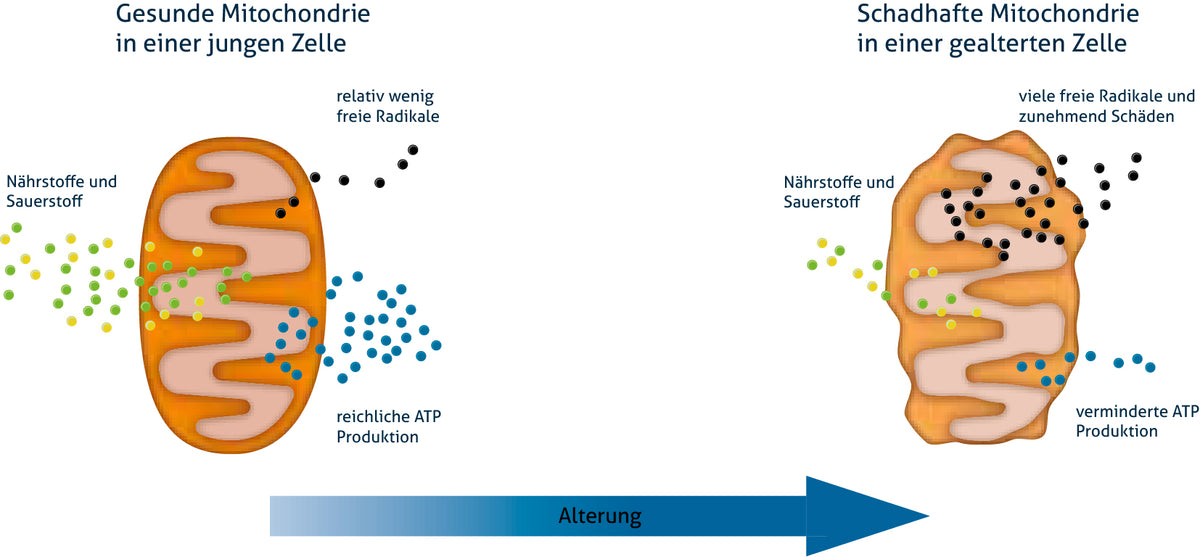
The provision of energy for all metabolic processes in our organism takes place for the most part via the respiratory chain in the mitochondria ("power plants of the cells"). Depending on their function and their energy requirement, the cells of our body contain up to 1,600 mitochondria.
The bioenergetic state, and thus the performance and survival of a cell, depends on the number of intact mitochondria and on how well they are supplied with macronutrients and micronutrients. When about 40% of the mitochondria are damaged, the first symptoms of an energy deficiency appear. If the degree of damage rises further, the typical symptoms of chronic diseases manifest themselves.
The causes and consequences of burnout syndrome mentioned above (oxidative and nitrosative stress, mental stress, chronic inflammation, infections as well as a lack of vitamins, minerals and trace elements) can lead to damage to the mitochondria. Energy production is disturbed. The activities in complexes I, II and III of the mitochondrial respiratory chain in particular are noticeably reduced.
The most effective treatment of burnout syndrome is timely and consistent prevention. This includes:
• sufficient sleep
• optimising the energy and micronutrient balance
• regular physical activity in reasonable measure
• a healthy diet
• alcohol and coffee in moderation, avoiding nicotine
• learning relaxation techniques and stress management
• maintaining contacts and hobbies
• learning to say “no”
People with advanced burnout syndrome need professional help. Important preconditions for recovery are physical recuperation and stepping out for a time in order to give body and mind rest.
Treatment with antidepressants is often recommended but is risky in so far as burnout depression is generally the result of massive exhaustion. This distinguishes it considerably from depression that has a different cause.
The relevant mitotropic substances
A large number of what are known as mitotropic substances (see the consumer information on mitotropic substances) contribute directly and indirectly to maintaining the natural function of the mitochondria and to protecting them. These substances, mostly native to the body, generally play central roles in mitochondrial metabolism and are essential for many metabolic reactions. Avoiding, or compensating for, deficiencies of these substances can contribute to maintaining particularly energy-intensive bodily functions.
The following briefly explains the relevant mitotropic substances for the treatment and prevention of burnout syndrome. These and further descriptions of important mitotropic substances can also be found in our consumer information on mitotropic substances.
The effects of burnout syndrome represent a great burden for those affected, because burnout patients are considerably restricted both personally and professionally. A large number of clinical investigations and scientific papers show that the needs-based use of mitotropic substances can positively influence the natural functions of the mitochondria and thus of the body. The supply of micronutrients therefore also represents a promising possibility for the supportive treatment of burnout syndrome. As numerous widespread clinical conditions affect the mitochondria directly or indirectly, accompanying treatment according to the MitoMed concept appears advisable in many cases.
Omega-3 fatty acids
Omega-3 fatty acids are building blocks of the membranes (cells, mitochondria, red blood cells and others) and starting substances for the formation of tissue hormones, which play an important role as local messengers in signal transmission. They have an important function with regard to the correct composition of the blood lipids and thus the flow properties of the blood as well as the blood circulation (through the formation of vasodilating tissue hormones). Omega-3 fatty acids are also needed for blood pressure, the flexibility of the cell membranes, the immune system, our skin metabolism, the cardiovascular system and brain and memory performance.
The mse product EnzOmega® contains 750 mg of omega-3 fatty acids per capsule, of which 500 mg eicosapentaenoic acid (EPA) and 250 mg docosahexaenoic acid (DHA) in the physiological ratio of 2:1.


Ubiquinol / ubiquinone Q10
Q10 occurs in all cells of our organism. It is a key substance for energy production in the mitochondria and is vital for the entire organism. Coenzyme Q10 is the only lipophilic (fat-soluble) antioxidant produced by the body itself and plays an essential part in protecting the cells from free radicals. As free radicals are formed in particular during energy production in the mitochondria, the Q10 within them contributes not only significantly to the energy supply but also to the protection of the mitochondria. Coenzyme Q10 also fulfils further important functions. It keeps the cell membranes fluid and functional and is involved in the exchange of substances and information between the cells. Q10 is barely metabolised in the body and is excreted intact in the stool. An external supply therefore places no additional burden on the liver or kidneys. The product range of mse Pharmazeutika GmbH includes numerous Q10 products with individual advantages. We will gladly advise you on which product is the right one for you.


Vitamin B3 – niacinamide
Niacinamide, like Q10, occurs in all cells of our organism. As a coenzyme building block of nicotinamide adenine dinucleotide (NAD) and nicotinamide adenine dinucleotide phosphate (NADP) it is involved in numerous enzymatic reactions of the metabolism and plays a significant part in energy production in the mitochondria. Its function is, among other things, closely linked to ubiquinol/ubiquinone Q10. It also plays a role in the defence against reactive free radicals and takes part in the regeneration of Q10 into its active form.
The mse product TriaMit-B® contains vitamin B3 as niacinamide and can be used to compensate for a bioenergetic deficit in the body. In addition to vitamin B3, RiboMit® also contains vitamin B2 and ubiquinol Q10.


Vitamin C - ascorbic acid
The importance of vitamin C for our defence system is widely known. However, the substance performs numerous further functions in the body. Among other things it is indispensable for the formation and function of collagen (an essential component of the connective tissue), and it is involved as a cofactor in the formation of hypothalamic hormones, messenger substances and detoxification processes. Beyond this, vitamin C is regarded as one of the most important antioxidants and as a very effective radical scavenger in our organism. It should be emphasised that vitamin C protects against reperfusion injury (reduced blood flow) during operations. It also regenerates vitamin E.
As excessive doses (more than 50 to 80 mg) are excreted via the kidneys, it is important to use a product that releases vitamin C evenly over a long period (6 to 8 hours) without burdening the kidneys. Vitamin C mse matrix 500 mg meets these requirements.


