


Health begins in the mouth
Consumer information; a service provided by mse Pharmazeutika GmbH

Health begins in the mouth: the importance of oral care
"Health begins in the mouth" – many people know this saying. But few know that it refers not only to the health of the teeth but to that of the whole body. It is in fact the case that poor oral hygiene can be the starting point for many diseases that can also occur outside the oral cavity. Thorough oral care is therefore even more important than one might think. Oral care is the collective term for all hygiene measures within the oral cavity. These include the daily cleaning and care of the teeth, the spaces between the teeth, the gums and, where appropriate, the tongue. As a rule, consumers understand oral hygiene above all as caring for their teeth. Yet daily preventive care of the gums is just as important, because intact gums are also the precondition for healthy teeth.
The causes of all gum problems
Taking gum problems seriously
The gums are part of the oral mucosa. They cover the jawbones and enclose the necks of the teeth. Healthy gums are firm, slightly stippled and pale pink in colour. The gums fulfil two important functions: first, they are part of the periodontium and anchor the tooth in the jaw. Second, they protect the sensitive tooth root from invading bacteria by closely enclosing the tooth.
The neck of the tooth and the tooth roots in particular have only a very thin layer of enamel, which does not protect them sufficiently from bacteria. The spaces between the teeth are also filled by the gums.
An inflammation of the gums is called gingivitis. If the inflammation persists over a longer period, periodontitis can develop from it, that is an inflammation of the tooth bed, which can culminate in the loss of a tooth through the destruction of the periodontium. From the age of 40 it is more likely that a tooth will be lost through gum disease than through caries.
The causes of all gum problems are above all the harmful bacteria present in dental plaque and their metabolic products (see the section “oral flora"). Dental plaque consists of bacteria, food residues and saliva. It forms shortly after brushing the teeth, above all between the neck of the tooth and the gums, but also in the spaces between the teeth and in the grooves of the chewing surfaces.
Through the hardening of plaque, tartar forms, on which further plaque accumulates. In plaque the bacteria find ideal living conditions and therefore multiply very rapidly: the older the plaque, the higher the number of bacteria. They excrete toxins and acids that damage the teeth and the gums.
The following factors can encourage gum problems:
• inadequate oral hygiene
• excess weight
• an unsuitable diet
• stress
• smoking
• high blood pressure
• diabetes
• a weakening of the immune system
Consequences
Inflammation of the gums (gingivitis) is the initial stage of gum problems. Bacteria in plaque can attack the junctional cells of the gums (special cells by which the gums adhere to the neck of the tooth) and detach them from the tooth. The toxins of the microorganisms can then penetrate into the now softened gums and cause inflammation there. The affected areas of the gums show painful redness and swelling, often accompanied by pronounced bad breath. The gums can hurt and bleed when brushing the teeth and when eating.
If inflammation of the gums (gingivitis) is not treated and persists over a longer period, it can develop into a disease of the tooth bed (periodontitis) or, where periodontitis already exists, accelerate its course.
The bacteria can then penetrate deeper into the gums and the inflammation can spread into deeper layers of the gums. Between the detached gum margin and the gums a pocket can form in which the bacteria can no longer be reached by the toothbrush.
If the periodontitis becomes chronic, a gradual damaging of the periodontium and of the jawbone substance can take place, so that the affected tooth loses its hold and falls out.
Oral flora
The oral cavity is colonised by more than 50 billion bacteria and yeasts belonging to more than 600 species. There is a balance between the various germs. The microorganisms adhere to the teeth, to the mucosa and to the tongue.
The oral flora has above all a protective function against unwanted germs. At the same time it can support the immune system. An oral flora in balance is a basic precondition for healthy gums and healthy teeth. Changes in the oral flora can therefore lead not only to bad breath but also to problems with the teeth and gums.
The balance of the oral flora can be disturbed by various factors, such as a diet rich in sugar, certain medicines, but also excessive oral hygiene.
Periodontitis can reach beyond the mouth
One species of bacteria that is decisively involved in the development of severe periodontitis is Porphyromonas gingivalis. Research findings have been able to show that the bacterium is not only involved in the development of periodontitis. Its metabolic end products have also been detected in the brain substance of Alzheimer's patients and are discussed as a possible trigger of the disease. The well-known peptide amyloid beta, which can likewise be found in the brain substance of Alzheimer's patients, is discussed here as a possible antibacterial substance (an endogenous antibiotic). If amyloid beta is deposited in larger quantities, however, it has a nerve-damaging effect. P. gingivalis has also already been detected in plaques in blood vessel walls, where it can contribute to the progression of atherosclerosis.
Mitochondria and oral health
The provision of energy for all metabolic processes in our organism takes place for the most part via the respiratory chain in the mitochondria (“power plants of the cells"). Depending on their function and their energy requirement, the cells in our body contain up to 1,600 mitochondria.
In the course of cellular energy production, particularly reactive ("aggressive") oxygen compounds, the free radicals, are constantly and naturally formed. Normally free radicals are rendered harmless by antioxidant defence substances. However, if the antioxidant capacity of the organism is limited by deficiencies, or if an inflammatory disease leads to an increased production of free radicals, the body's own defences are no longer sufficient and irreparable damage to the cells and mitochondria can occur.
The bioenergetic state, and thus the performance and survival of a cell, depends on the number of intact mitochondria and on how well they are supplied with macronutrients and micronutrients. When about 40% of the mitochondria are damaged, the first symptoms of an energy deficiency appear. If the degree of damage rises further, the typical symptoms of chronic diseases manifest themselves.
Preventive measures
Bacterial deposits and inflammation represent a major risk to oral health. As bacterial dental plaque is the main cause of both gum problems and caries, regular, thorough and correct oral and dental care can successfully prevent this.
Further important preventive measures are:
• regular check-ups by the dentist
• a healthy diet low in sugar
• use of mitotropic substances such as ubiquinol/ubiquinone Q10, vitamin C and D3
• avoiding nicotine
• supporting the immune system
• avoiding stress
• weight reduction
A large number of what are known as mitotropic substances contribute directly and indirectly to maintaining the natural function of the mitochondria and to protecting them. These substances, mostly native to the body, generally play central roles in mitochondrial metabolism and are essential for many metabolic reactions. Avoiding, or compensating for, deficiencies of these substances can contribute to maintaining normal cell functions. The following briefly discusses the relevant mitotropic substances for the treatment and prevention of inflammatory conditions in the mouth. The focus here is on supporting the antioxidant defences. The substances should also be chosen so as to shift the bacterial oral flora towards the desired (beneficial) bacteria.
DentoMit® Oral Care Spray and DentoMit® Tooth Gel
For targeted use in gum care, mse research has developed the products DentoMit® Oral Care Spray and DentoMit® Tooth Gel. Both products contain liquid Q10 in a patented formulation of ultra-small liquid particles. One spray of DentoMit® Oral Care Spray contains countless liquid particles. In this way the Q10 can reach even the smallest spaces between the teeth. The DentoMit® care range supports oral health and keeps the gums vital and resilient.


Ubiquinol / ubiquinone Q10
Q10 occurs in all cells of our organism. It is a key substance for energy production in the mitochondria and is vital for the entire organism. Coenzyme Q10 is the only lipophilic (fat-soluble) antioxidant produced by the body itself and plays an essential part in protecting the cells from free radicals. As free radicals are formed in particular during energy production in the mitochondria, the Q10 within them contributes not only significantly to the energy supply but also to the protection of the mitochondria. Coenzyme Q10 also fulfils further important functions. It keeps the cell membranes fluid and functional and is involved in the exchange of substances and information between the cells. Q10 is barely metabolised in the body and is excreted intact in the stool. An external supply therefore places no additional burden on the liver or kidneys. The product range of mse Pharmazeutika GmbH includes numerous Q10 products with individual advantages. We will gladly advise you on which product is the right one for you.


Omega-3 fatty acids
Omega-3 fatty acids are building blocks of the membranes (cells, mitochondria, red blood cells and others) and starting substances for the formation of tissue hormones, which play an important role as local messengers in signal transmission. They have an important function with regard to the correct composition of the blood lipids and thus the flow properties of the blood as well as the blood circulation (through the formation of vasodilating tissue hormones). Omega-3 fatty acids are also needed for blood pressure, the flexibility of the cell membranes, the immune system, our skin metabolism, the cardiovascular system and brain and memory performance.
The mse product EnzOmega® contains 750 mg of omega-3 fatty acids per capsule, of which 500 mg eicosapentaenoic acid (EPA) and 250 mg docosahexaenoic acid (DHA) in the physiological ratio of 2:1.


Ubiquinol / ubiquinone Q10
Q10 occurs in all cells of our organism. It is a key substance for energy production in the mitochondria and is vital for the entire organism. Coenzyme Q10 is the only lipophilic (fat-soluble) antioxidant produced by the body itself and plays an essential part in protecting the cells from free radicals. As free radicals are formed in particular during energy production in the mitochondria, the Q10 within them contributes not only significantly to the energy supply but also to the protection of the mitochondria. Coenzyme Q10 also fulfils further important functions. It keeps the cell membranes fluid and functional and is involved in the exchange of substances and information between the cells. Q10 is barely metabolised in the body and is excreted intact in the stool. An external supply therefore places no additional burden on the liver or kidneys. The product range of mse Pharmazeutika GmbH includes numerous Q10 products with individual advantages. We will gladly advise you on which product is the right one for you.
Vitamin B3 – niacinamide
Niacinamide, like Q10, occurs in all cells of our organism. As a coenzyme building block of nicotinamide adenine dinucleotide (NAD) and nicotinamide adenine dinucleotide phosphate (NADP) it is involved in numerous enzymatic reactions of the metabolism and plays a significant part in energy production in the mitochondria. Its function is, among other things, closely linked to ubiquinol/ubiquinone Q10. It also plays a role in the defence against reactive free radicals and takes part in the regeneration of Q10 into its active form.
The mse product TriaMit-B® contains vitamin B3 as niacinamide and can be used to compensate for a bioenergetic deficit in the body. In addition to vitamin B3, RiboMit® also contains vitamin B2 and ubiquinol Q10.


Vitamin C - ascorbic acid
The importance of vitamin C for our defence system is widely known. However, the substance performs numerous further functions in the body. Among other things it is indispensable for the formation and function of collagen (an essential component of the connective tissue), and it is involved as a cofactor in the formation of hypothalamic hormones, messenger substances and detoxification processes. Beyond this, vitamin C is regarded as one of the most important antioxidants and as a very effective radical scavenger in our organism. It should be emphasised that vitamin C protects against reperfusion injury (reduced blood flow) during operations. It also regenerates vitamin E.
As excessive doses (more than 50 to 80 mg) are excreted via the kidneys, it is important to use a product that releases vitamin C evenly over a long period (6 to 8 hours) without burdening the kidneys. Vitamin C mse matrix 500 mg meets these requirements.


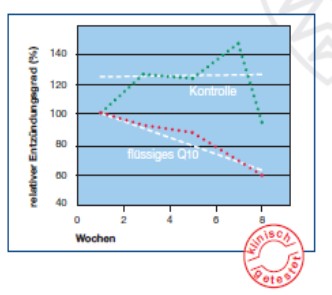
Course of inflammation treated with (red) or without (green) DentoMit®
In addition to liquid Q10, DentoMit® Oral Care Spray contains taurine. Taurine is a substance produced by the body itself, an aminosulfonic acid. After L-glutamine it is the most abundant amino acid in our body, although it is not involved in the formation of proteins. Taurine is found above all in the mitochondria and cell membranes. Membranes are important cell components, because they are where both the exchange of ions and the exchange of information between the cells and their environment take place. Energy production in the mitochondria also takes place at the inner membranes. Here taurine can prevent the formation of free radicals.


