


Mitotropic substances
A scientific service of mse pharmazeutika; Christian Huth, 2022

What are mitotropic substances?
More than 85% of the energy converted in the human body is produced in special cell organelles, the mitochondria. For this reason the mitochondria are often referred to, in simplified terms, as the power plants of the cells. Mitotropic substances are natural substances (enzymes, coenzymes, fatty acids, trace elements, minerals and so on) that belong to the body's own repertoire of mitochondrial biochemistry.
Mitotropic substances play decisive roles ...
- in energy production in the mitochondria.
- as antioxidants protecting against free radicals.
- as building blocks of the mitochondrial and cell membranes.
Ultimately they are substances of very different kinds that are indispensable for the biochemical processes within our mitochondria and that influence the functional capacity of the mitochondria positively.
Mitochondrial medicine – the MitoMed concept
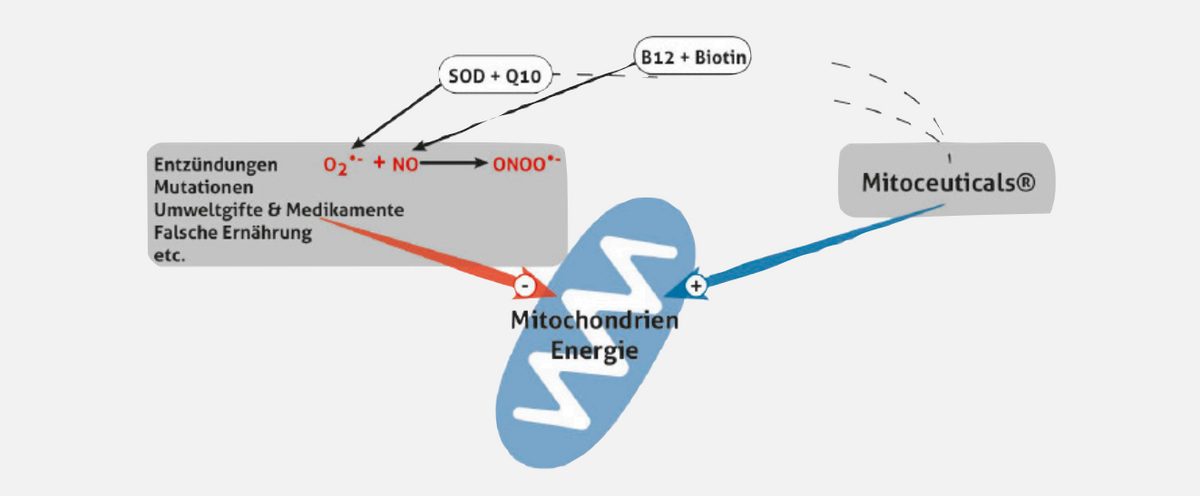
The MitoMed concept is an interdisciplinary treatment concept for health prevention and therapy. It is based exclusively on natural substances whose supporting function in energy metabolism and in the body's own defence against free radicals is scientifically proven. Through the needs-based use of this range of substances native to the body, natural bodily functions can be supported and a wide variety of disease symptoms treated or alleviated. Please also note our disease-related consumer information. We therefore also speak of Mitoceuticals® when we refer to preparations with high-dose mitotropic ingredients.
In principle the MitoMed concept can be reduced to five treatment goals:
- Maintaining membrane integrity and fluidity (omega-3 fatty acids) 2.
- Supporting energy production and supply (ubiquinol/ubiquinone Q10, vitamin B2, vitamin B3, magnesium, carnitine)
- Promoting the antioxidant enzyme complexes (superoxide dismutase, glutathione peroxidase, catalase)
- Supply of antioxidant micronutrients (vitamin B12, vitamin C, vitamin D3, alpha-lipoic acid)
- Supply of minerals and trace elements (magnesium, selenium, zincII, chromiumIII, manganeseII , iron, sulphur)
Overview of relevant mitotropic substances
Omega-3 fatty acids
Omega-3 fatty acids are building blocks of the membranes (cells, mitochondria, red blood cells and others) and starting substances for the formation of tissue hormones, which play an important role as local messengers in signal transmission. They have an important function with regard to the correct composition of the blood lipids and thus the flow properties of the blood as well as the blood circulation (through the formation of vasodilating tissue hormones). Omega-3 fatty acids are also needed for blood pressure, the flexibility of the cell membranes, the immune system, our skin metabolism, the cardiovascular system and brain and memory performance.
The mse product EnzOmega® contains 750 mg of omega-3 fatty acids per capsule, of which 500 mg eicosapentaenoic acid (EPA) and 250 mg docosahexaenoic acid (DHA) in the physiological ratio of 2:1.


Ubiquinol / ubiquinone Q10
Q10 occurs in all cells of our organism. It is a key substance for energy production in the mitochondria and is vital for the entire organism. Coenzyme Q10 is the only lipophilic (fat-soluble) antioxidant produced by the body itself and plays an essential part in protecting the cells from free radicals. As free radicals are formed in particular during energy production in the mitochondria, the Q10 within them contributes not only significantly to the energy supply but also to the protection of the mitochondria. Coenzyme Q10 also fulfils further important functions. It keeps the cell membranes fluid and functional and is involved in the exchange of substances and information between the cells. Q10 is barely metabolised in the body and is excreted intact in the stool. An external supply therefore places no additional burden on the liver or kidneys. The product range of mse Pharmazeutika GmbH includes numerous Q10 products with individual advantages. We will gladly advise you on which product is the right one for you.


Vitamin B3 – niacinamide
Niacinamide, like Q10, occurs in all cells of our organism. As a coenzyme building block of nicotinamide adenine dinucleotide (NAD) and nicotinamide adenine dinucleotide phosphate (NADP) it is involved in numerous enzymatic reactions of the metabolism and plays a significant part in energy production in the mitochondria. Its function is, among other things, closely linked to ubiquinol/ubiquinone Q10. It also plays a role in the defence against reactive free radicals and takes part in the regeneration of Q10 into its active form.
The mse product TriaMit-B® contains vitamin B3 as niacinamide and can be used to compensate for a bioenergetic deficit in the body. In addition to vitamin B3, RiboMit® also contains vitamin B2 and ubiquinol Q10.


Vitamin C - ascorbic acid
The importance of vitamin C for our defence system is widely known. However, the substance performs numerous further functions in the body. Among other things it is indispensable for the formation and function of collagen (an essential component of the connective tissue), and it is involved as a cofactor in the formation of hypothalamic hormones, messenger substances and detoxification processes. Beyond this, vitamin C is regarded as one of the most important antioxidants and as a very effective radical scavenger in our organism. It should be emphasised that vitamin C protects against reperfusion injury (reduced blood flow) during operations. It also regenerates vitamin E.
As excessive doses (more than 50 to 80 mg) are excreted via the kidneys, it is important to use a product that releases vitamin C evenly over a long period (6 to 8 hours) without burdening the kidneys. Vitamin C mse matrix 500 mg meets these requirements.


