


New therapeutic approaches for sleep apnea
A service provided by mse Pharmazeutika GmbH

Obstructive sleep apnoea (OSA)
Obstructive sleep apnoea (OSA) is characterised by the periodic interruption of breathing due to the collapse of the upper airways. This happens, for example, through the slackening of the upper pharyngeal muscles. As a result the supply of oxygen is reduced or interrupted completely. There is a drop in oxygen saturation in the blood and a rise in CO2 content, and therefore a more or less conscious awakening, so that restful night-time sleep is disturbed. Approximately 3 to 7 % of the male and 2 to 5 % of the female population suffer from sleep apnoea, and the number of unreported cases is presumably higher. Risk factors for developing sleep apnoea are excess weight, pre-existing cardiovascular disease or other conditions such as acromegaly or an underactive thyroid. Men are also affected more often than women. In most cases there is an altered anatomy of the pharyngeal area. The greater the proportion of soft tissue, the more likely a narrowing of the airways. In contrast to this there is also central sleep apnoea, in which the breathing impulse in the brain is suspended. However, this form of sleep apnoea occurs in only about 10 % of sleep apnoea patients. In mixed apnoea both the airways are narrowed and the breathing impulse during sleep is disturbed.
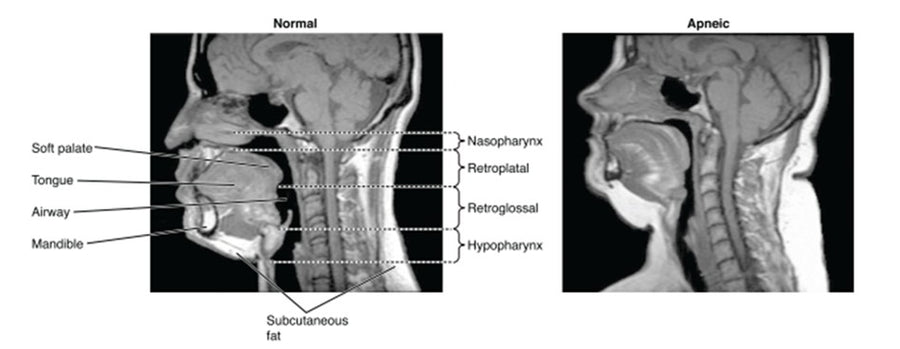
Magnetic resonance image of the upper airways
Left: healthy person, right: patient with obstructive sleep apnoea. The entire pharyngeal space of the patient with sleep apnoea is narrowed. From: Dempsey & Veasey 2010.
When the airway is restricted
Signs and symptoms of an existing sleep apnoea are loud or irregular snoring, daytime tiredness, the feeling of not having had restful sleep, the need to urinate at night, a dry mouth on waking and morning headaches.
Obstructive apnoeas are defined as an almost complete interruption of airflow (>90 %) for more than 10 seconds despite efforts to breathe. Hypopnoeas are restrictions of airflow (for example through the partial collapse of the airways) by more than 30 % with a fall in blood oxygen content of at least 4 % or an arousal event. The waking does not necessarily have to happen consciously, but in every case the pulse is accelerated and stress hormones are released, so that restful sleep is disturbed. In order to determine the severity of sleep apnoea there is what is known as the apnoea-hypopnoea index (AHI), which assigns the number of individual apnoea events per night to severity categories. Patients with an AHI of more than 30 apnoea events per hour accordingly have severe obstructive sleep apnoea. Normally sleep apnoea patients have no problems controlling their breathing while they are awake.
Treatment options are, on the one hand, being provided with a breathing mask that keeps the airways open by air pressure (continuous positive airway pressure, CPAP). This can lower the AHI to below 5, although it can be difficult and uncomfortable for the patient to position the mask correctly. Sleep apnoea also cannot be cured by a CPAP mask, so that the mask has to be used for life. Alternatively there is the possibility of preventing the pharyngeal space from collapsing with a splint or of achieving the same through surgical correction.
The quality of life of patients with obstructive sleep apnoea is often massively restricted. The lack of restful sleep at night produces daytime tiredness, which can not only lead to falling asleep in inappropriate social situations but also brings with it a reduction in physical and mental performance. As a result the patients are in part restricted in their daily activities (up to the point of being unable to work) and in their social contacts, which can lead to the development of depression. The greatest risk, however, is what is known as microsleep while driving or operating machinery, which puts the patients and others in danger.
The precise economic consequences of sleep apnoea can only be estimated and, through sleep apnoea and its direct (medical) and indirect consequences, amount to more than 100 billion dollars per year in the USA, which is comparable with other chronic diseases. A large proportion of this is taken up by the consequences of road accidents, for which sleep apnoea patients have a three to seven times higher risk.
The consequences of sleep apnoea
Obstructive sleep apnoea is a risk factor for cardiovascular diseases such as cardiac arrhythmia during sleep, heart failure or strokes. For example, the risk of hypertension is three times higher in patients with moderate to severe obstructive sleep apnoea (OSA), because obstructive sleep apnoea is frequently accompanied by a rise in blood pressure. The reactive oxygen species that arise as a result of periods of poor oxygen supply during sleep also play an important role in the development of cardiovascular diseases. This is roughly comparable to the conditions that prevail in what is known as ischaemia/reperfusion syndrome. This involves tissue damage caused by the restoration of blood flow after a more or less intensive reduction in blood flow. With OSA the extent is smaller, but it can nevertheless cause damage to the mitochondria, inflammatory reactions and damage to the blood vessels, which can be attenuated by CPAP treatment. Obstructive sleep apnoea is also a risk factor for arteriosclerosis and arrhythmia as well as diabetes.
In addition, sleep apnoea contributes to cognitive impairment and neuronal damage. Many patients show attention deficits, memory and learning difficulties and are overwhelmed in complex situations such as road traffic. Even if the sleep apnoea itself can be improved by CPAP treatment, the cognitive impairments often remain, because the undersupply of oxygen and the resulting interruptions of sleep lead in the long run to neuronal damage in the brain, particularly in areas responsible for memory and for carrying out tasks.
Sleep apnoea and mitochondrial medicine
In the mitochondria the energy from our food is converted into a form usable by our body, adenosine triphosphate (ATP). This takes place in what is known as the respiratory chain, in which various complexes in the inner mitochondrial membrane are involved. As natural by-products, reactive oxygen species (ROS) can arise, above all the superoxide radical /O2-•. In a healthy body this is converted into water by antioxidant enzymes within the mitochondria. If too much ROS is formed, however, the antioxidant reserves can reach their limits and the superoxide radical can cause damage to proteins, lipids, the genetic material (DNA) and cell components.
Increased oxidative stress, as a consequence of which ROS can arise, can be the cause of cell damage and ultimately of many different diseases. In patients with obstructive sleep apnoea, a disturbed regulation of oxidative stress as well as a disturbed energy metabolism are suspected.
A large number of mitotropic substances contribute directly and indirectly to maintaining the natural function of the mitochondria and to protecting them. These substances, mostly native to the body, generally play central roles in mitochondrial metabolism and are essential for many metabolic reactions.


