


Ubiquinol versus Ubiquinone:

A scientific comparison
Coenzyme Q10 (CoQ10) is one of the best-selling mitochondrial food supplements worldwide, with a global market volume of more than 700 million euros and steady growth, driven by an ageing society and a growing awareness of the importance of the mitochondria for our health. It plays a central role in mitochondrial energy production and acts as a fat-soluble antioxidant. Yet anyone buying CoQ10 often does not look twice at the packaging, even though this one piece of information determines how much of the active ingredient actually reaches the body: does it say ubiquinone or ubiquinol? Both terms describe the same molecule, in different states. And for supplementation this difference matters more than many consumers are aware. This article examines the scientific evidence on both forms, explains the need for enzymatic cofactors and offers guidance for choosing the right dosage form.
1. The two faces of coenzyme Q10: oxidised and reduced
Coenzyme Q10 occurs in the human body in two mutually convertible forms. Ubiquinone is the fully oxidised form and is the version that the body itself synthesises in the mitochondrial membrane. However, in order for CoQ10 to fulfil its function as an electron carrier in the respiratory chain, it has to be able to take up electrons. This happens through reduction to ubiquinol. In this reduced form it can effectively neutralise free radicals and act as an antioxidant. Several studies suggest that ubiquinol could have a higher oral bioavailability than ubiquinone.
In healthy, younger adults about 90 to 95 % of the total CoQ10 in the blood is in the reduced form (ubiquinol). The body has a sophisticated enzyme system that can convert both forms into each other as required. This natural homeostasis is the central starting point for the discussion about the right supplementation strategy, because both forms have their place.
The decisive question for consumers is which form is better absorbed by the body and reaches the blood, in other words which is more bioavailable. The body of studies provides a nuanced picture here.
2. Absorption and bioavailability: what does science say?
An in vitro study from 2014[i] investigated this using a simulated digestion model and Caco-2 intestinal cells. The results showed that during digestion ubiquinol is incorporated into mixed micelles more efficiently than ubiquinone. Micelles are the transport vehicles by which fats and fat-soluble substances are taken up by the intestinal cells. The researchers also found that the uptake of ubiquinol into the cells and its subsequent release on the basolateral side (that is, towards the bloodstream) was dependent on glutathione (GSH) and was more pronounced with ubiquinol.
First indications from animal models suggest that both forms remain largely stable in the small intestine, which still has to be confirmed by human studies. This means that ubiquinol is not significantly oxidised to ubiquinone in the digestive tract and, conversely, that ubiquinone is not reduced. This suggests that in principle both forms can be absorbed without a prior conversion in the intestinal lumen being strictly necessary. A human study published in 2018 in Food & Function (RSC Publishing) with 10 older men (>55 years) taking 200 mg/day over 2 weeks found: ubiquinol increased the plasma CoQ10 level significantly more than ubiquinone.
A comprehensive review by Mantle et al. (2020) also emphasises that the initial formulation of the preparation, that is whether it is a crystalline powder or an oily solution or dispersion, has a considerably greater influence on bioavailability than the question of ubiquinol or ubiquinone. A poor crystal dispersion can reduce bioavailability by up to 75 %. This means that powders, or powder capsules, are absorbed considerably less effectively by the body.
[i] Failla, M. L., et al. (2014).
Increased bioavailability of ubiquinol compared to that of ubiquinone is due to more efficient micellarization during digestion and greater GSH-dependent uptake and basolateral secretion by Caco-2 cells. Journal of Agricultural and Food Chemistry, 62(29), 7174-7182. DOI: 10.1021/jf5017829
3. Enzymatic conversion: does the body need cofactors?
From a scientific point of view the question arises of how efficiently the ageing organism can convert ubiquinone enzymatically into ubiquinol. Investigations of human liver tissue show an age-associated decrease in NQO1 protein expression (Bhat et al., 2016). In parallel, the NAD+/NADH ratio shifts with age in favour of NADH, which limits the availability of cofactors for these reductases. The connection is well founded biologically, even if it has not yet been conclusively quantified clinically. This suggests that older people could benefit more from direct supplementation with ubiquinol than from ubiquinone. A study by Langsjoen et al. from 2014 shows that ubiquinol is absorbed somewhat better. The conversion of ubiquinone to ubiquinol is indeed an enzymatic process. The reduction is catalysed by NADPH-dependent enzymes such as NADPH ubiquinone oxidoreductase (NQO1) and other cellular reductases.
These enzymes are present in the liver and in the intestinal cells. In healthy people this conversion works efficiently. The question is at what point this capacity is exhausted. Research on primary CoQ10 deficiencies shows that severe genetic defects in the enzymes of biosynthesis (such as COQ2 or PDSS2) lead to a clinical picture that has to be treated by high-dose supplementation. For the healthy average consumer, however, there is no clear evidence that the conversion capacity is limiting. The theory that older people fundamentally need ubiquinol because their conversion is disturbed is not conclusively proven scientifically, but it can nevertheless be assumed that the ability to convert slowly decreases with increasing age.
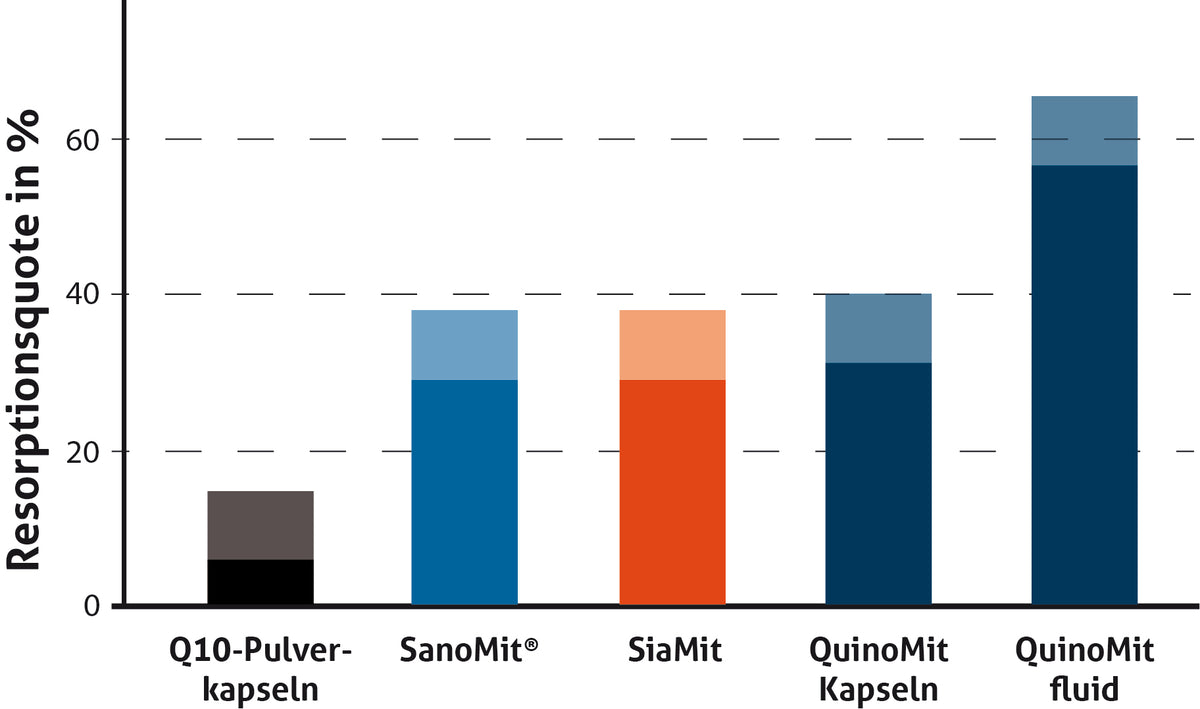
4. Dosage forms: the key to bioavailability
Regardless of the chemical form, galenics (the dosage form) is the decisive factor for absorption. As CoQ10 is lipophilic (fat-loving), oily solutions in soft gelatine capsules (softgels) are clearly superior to dry powders in tablets or hard capsules. Better still are liquid forms in which the ubiquinol is present in ultra-small droplets, as a Spanish study by Guillermo López-Lluch et al. from 2018 showed.
The following dosage forms have proved effective:
• Oil-based softgels: CoQ10 is dissolved in oils (for example soy, olive or medium-chain triglycerides). This is the most common form and the one best investigated scientifically.
• Nanostructured liquid formulations: these technologies (for example nano-emulsified or micellisation) reduce the size of the CoQ10 particles in order to increase the surface area for absorption. They can increase bioavailability considerably but are more expensive.
• Dry powders in tablets/capsules: here CoQ10 is in crystalline form. This form shows by far the poorest absorption.
The current state of the art is formed by nano water-based formulations: by reducing CoQ10 particles to the nanometre range, the dependence on dietary fat taken at the same time disappears completely. The ubiquinol can already be absorbed through the oral mucosa, which further accelerates uptake and allows intake independently of meals. Internal comparative data show a bioavailability up to 8 times higher than that of conventional powder formulations.
5. Practical recommendations for choosing a preparation
The decision for ubiquinol or ubiquinone should be made individually: for healthy adults, high-quality ubiquinone is a scientifically sound and cost-efficient choice. Studies show that comparable blood levels can be achieved with it as with more expensive forms.
For older people or people with absorption disorders: ubiquinol could offer advantages here, as it is already in the active form and the delay caused by the enzymatic conversion is bypassed. Some studies indicate higher plasma levels when ubiquinol is taken. If it is in liquid form, absorption is increased further still.
Quality aspects: look for manufacturers who have their products tested by third parties and who produce according to GMP guidelines (Good Manufacturing Practice). The daily dose is usually between 100 and 200 mg. Higher doses can be sensible in exceptional cases but should be discussed with a doctor. Interactions: CoQ10 can influence the effect of blood thinners (for example warfarin). If such medicines are being taken, a doctor must be consulted before supplementation. With some medicines, taking CoQ10 can strengthen the effect of the medicine, which is why the dosage might under certain circumstances have to be reduced. Dr Kuklinski, at the time head of internal medicine at the Rostock clinic, had observed that patients with kidney insufficiency were gradually able to do without diuretics when ubiquinol was given over a longer period. An effect that he attributes to an increased performance of the kidneys through the Q10 itself.
General reference values:
• Maintenance dose (healthy adults): 100–200 mg/day
• Therapeutic dosage (for example with heart failure, statin therapy): 300–600 mg/day
• With nano-formulated CoQ10: because of the higher bioavailability, lower amounts can be sufficient; consultation with a therapist is recommended here
The story behind the dosage – Dr Enzmann and Stanford:
What is the right dose? Dr rer. nat. Enzmann was already asking himself this question in 1967, when he systematically investigated dosage data on CoQ10 at Stanford University. In an animal model with mice suffering from Duchenne muscular dystrophy it emerged that only from a dose of 10 mg per kilogram of body weight did a therapeutically effective result appear: the animals were able to function normally again. This observation pointed the way. It laid the foundation for Dr Enzmann's later life's work as a pioneer of mitochondrial medicine and motivated the development of high-dose, bioavailable formulations, among them the first nano-liquid ubiquinol that he brought to market. Internal comparative measurements show that the water-based nano formulation of QuinoMit® Q10 fluid has a bioavailability up to 8 times higher than conventional CoQ10 powder capsules. This difference is due to the drastic reduction in particle size and the possibility of mucosal absorption.
Conclusion: Both ubiquinol and ubiquinone can raise the CoQ10 level in the body. Bioavailability is determined primarily by an intelligent dosage form, for example by ultra-small particles. The choice of the chemical form is secondary for as long as the enzymatic conversion in the body is intact. When in doubt, you are on the safe side with ubiquinol.
Sources:
Failla, M. L., et al. (2014). Increased bioavailability of ubiquinol compared to that of ubiquinone is due to more efficient micellarization during digestion and greater GSH-dependent uptake and basolateral secretion by Caco-2 cells. Journal of Agricultural and Food Chemistry, 62(29), 7174-7182. DOI: 10.1021/jf5017829
Kubo, H., et al. (2023). Orally ingested ubiquinol-10 or ubiquinone-10 reaches the intestinal tract and is absorbed by the small intestine of mice mostly in its original form. Journal of Clinical Biochemistry and Nutrition, 72(2), 101-106. DOI: 10.3164/jcbn.22-91
Mantle, D., & Dybring, A. (2020). Bioavailability of Coenzyme Q10: An Overview of the Absorption Process and Subsequent Metabolism. Antioxidants, 9(5), 386.
Langsjoen PH, et al. Comparison study of plasma coenzyme Q10 levels in healthy subjects supplemented with ubiquinol versus ubiquinone. Eur J Nutr. 2014;53(4):919–928.
López-Lluch G et al. Bioavailability of coenzyme Q10 supplements depends on carrier lipids and solubilization; DOI: 10.1016/j.nut.2018.05.020


