


Heart disease
Consumer information; a service of mse Pharmazeutika GmbH

Structure and function of the heart
The heart is probably the most important muscle in our body. It is roughly the size of a fist and forms four cavities: the right and left atrium and the right and left ventricle. The chamber system of the heart is a central pivot of the blood vessel system. From its position between the lungs and behind the breastbone it performs heavy work every day. Every minute the heart muscle contracts about 55 to 80 times and in this way pumps around 5 litres of blood per minute through our organism. Over the course of a human life, some 3 billion heartbeats pump a total volume of 250 million litres of blood through the body. In order to maintain this outstanding performance and to supply the heart muscle cells optimally, the heart has a particularly well developed blood vessel system of its own, the coronary vessels (coronary arteries).
Together, the heart and the blood vessels (arteries and veins) form the cardiovascular system. Put simply, blood flows through the arteries from the heart to the organs and through the veins from the organs to the heart. A distinction is made between the lesser circulation (pulmonary circulation) and the greater circulation (systemic circulation). The pulmonary circulation carries oxygen-poor blood through the lungs, where it is enriched with oxygen from the air we breathe. The systemic circulation then pumps the oxygen-rich blood into the rest of the organism. In this way the constant supply of the body with oxygen and nutrients and the removal of metabolic end products are ensured.
Diagnosis of heart disease
The term heart disease generally covers those conditions that manifest themselves in the heart or have their origin in the heart. Typical examples of heart disease are coronary heart disease, heart valve defects, cardiac arrhythmia or myocarditis. All of them fall within the medical specialty of cardiology.
Many of these conditions have in common that in their course they can lead to a reduced performance of the heart, what is known as heart failure. The heart is then no longer able to supply the body with sufficient blood.
Heart disease can be hereditary (congenital) or can develop in the course of life, for example as a result of an unhealthy lifestyle or with age. In many cases heart disease is preceded by a narrowing or blockage of the coronary vessels through deposits on the vessel wall (arteriosclerosis). As a result the heart itself is no longer sufficiently supplied with blood and a loss of function of the heart muscle tissue can occur.
The consequences of heart disease are complex for our organism and are differently pronounced in every patient. Because of the disturbed blood flow, the body's cells can only be supplied insufficiently with nutrients and oxygen. In addition, metabolic end products can be deposited in the tissues and cells because they can no longer be fully removed.
Because of the insufficient supply, a bioenergetic deficit, or in everyday language an energy deficiency, can arise in the tissue. As a consequence, the circulatory disturbances can lead to damage to the undersupplied tissues and to resulting functional disorders of tissues and organs. In extreme cases this can lead to the development of chronic states of exhaustion.
The symptoms of the various heart diseases are as varied as the conditions themselves. Indications of heart disease can be chest pain, sweating, nausea, shortness of breath, chronic tiredness, breathlessness or the sudden occurrence of palpitations.
In order to establish a potential heart condition beyond doubt, a cardiologist should always be consulted who can carry out an appropriate examination of the heart functions. In addition, regular medical check-ups are advisable in order to recognise and treat beginning conditions at an early stage.
Mitochondria and the heart
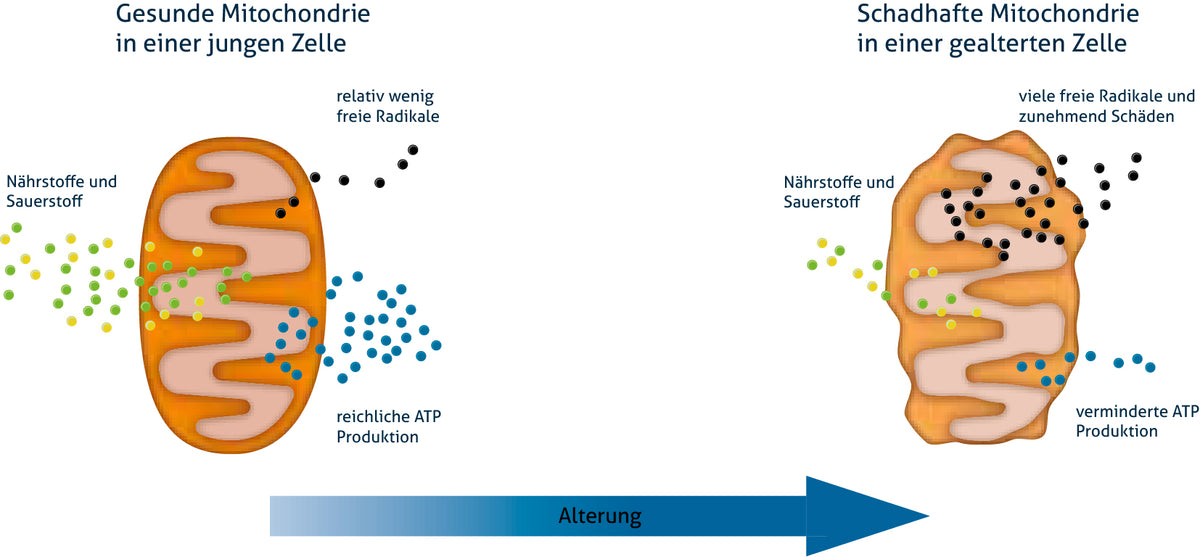
The provision of energy for all metabolic processes in our organism takes place for the most part via the respiratory chain in the mitochondria ("power plants of the cells"). Because of their function, the muscle cells of the heart have a very high energy requirement and each contain about 1,600 mitochondria. In addition, compared with cells from other organs, heart muscle cells are distinguished by an exceptionally high content of ubiquinone Q10 (>100µg/g).
The bioenergetic state, and thus the performance and survival of a cell, depends on the number of intact mitochondria and on how well they are supplied with macronutrients and micronutrients. When about 40% of the mitochondria are damaged, the first symptoms of an energy deficiency appear. If the degree of damage rises further, the typical symptoms of chronic diseases manifest themselves.
Preventive measures
In the past a number of simple preventive measures were proposed for protection against heart weakness and heart disease. These measures include avoiding or reducing excess weight through a balanced and conscious diet following the principle of a LOGI diet (low glycemic index), an increased intake of omega-3 fatty acids as well as a restriction of alcohol and tobacco consumption. Regular daily exercise and avoiding, or consciously handling, everyday stressful situations also appear advisable.
Dietary measures with heart disease
The goal of dietary measures with heart disease must be to support the mitochondria in their natural function and at the same time to protect them from the harmful effects of free radicals. Scientific studies show that these goals can be pursued through the targeted, needs-based use of a number of natural or nature-identical substances.
Relevant mitotropic substances
A large number of what are known as mitotropic substances (see the consumer information on mitotropic substances) contribute directly and indirectly to maintaining the natural function of the mitochondria and to protecting them. These substances, mostly native to the body, generally play central roles in mitochondrial metabolism and are essential for many metabolic reactions. Avoiding, or compensating for, deficiencies of these substances can contribute to maintaining particularly energy-intensive bodily functions.
The following briefly explains the relevant mitotropic substances for the treatment and prevention of heart disease. These and further descriptions of important mitotropic substances can also be found in our consumer information on mitotropic substances.
Omega-3 fatty acids
Omega-3 fatty acids are building blocks of the membranes (cells, mitochondria, red blood cells and others) and starting substances for the formation of tissue hormones, which play an important role as local messengers in signal transmission. They have an important function with regard to the correct composition of the blood lipids and thus the flow properties of the blood as well as the blood circulation (through the formation of vasodilating tissue hormones). Omega-3 fatty acids are also needed for blood pressure, the flexibility of the cell membranes, the immune system, our skin metabolism, the cardiovascular system and brain and memory performance.
The mse product EnzOmega® contains 750 mg of omega-3 fatty acids per capsule, of which 500 mg eicosapentaenoic acid (EPA) and 250 mg docosahexaenoic acid (DHA) in the physiological ratio of 2:1.


Ubiquinol / ubiquinone Q10
Q10 occurs in all cells of our organism. It is a key substance for energy production in the mitochondria and is vital for the entire organism. Coenzyme Q10 is the only lipophilic (fat-soluble) antioxidant produced by the body itself and plays an essential part in protecting the cells from free radicals. As free radicals are formed in particular during energy production in the mitochondria, the Q10 within them contributes not only significantly to the energy supply but also to the protection of the mitochondria. Coenzyme Q10 also fulfils further important functions. It keeps the cell membranes fluid and functional and is involved in the exchange of substances and information between the cells. Q10 is barely metabolised in the body and is excreted intact in the stool. An external supply therefore places no additional burden on the liver or kidneys. The product range of mse Pharmazeutika GmbH includes numerous Q10 products with individual advantages. We will gladly advise you on which product is the right one for you.


Vitamin B3 – niacinamide
Niacinamide, like Q10, occurs in all cells of our organism. As a coenzyme building block of nicotinamide adenine dinucleotide (NAD) and nicotinamide adenine dinucleotide phosphate (NADP) it is involved in numerous enzymatic reactions of the metabolism and plays a significant part in energy production in the mitochondria. Its function is, among other things, closely linked to ubiquinol/ubiquinone Q10. It also plays a role in the defence against reactive free radicals and takes part in the regeneration of Q10 into its active form.
The mse product TriaMit-B® contains vitamin B3 as niacinamide and can be used to compensate for a bioenergetic deficit in the body. In addition to vitamin B3, RiboMit® also contains vitamin B2 and ubiquinol Q10.


Vitamin C - ascorbic acid
The importance of vitamin C for our defence system is widely known. However, the substance performs numerous further functions in the body. Among other things it is indispensable for the formation and function of collagen (an essential component of the connective tissue), and it is involved as a cofactor in the formation of hypothalamic hormones, messenger substances and detoxification processes. Beyond this, vitamin C is regarded as one of the most important antioxidants and as a very effective radical scavenger in our organism. It should be emphasised that vitamin C protects against reperfusion injury (reduced blood flow) during operations. It also regenerates vitamin E.
As excessive doses (more than 50 to 80 mg) are excreted via the kidneys, it is important to use a product that releases vitamin C evenly over a long period (6 to 8 hours) without burdening the kidneys. Vitamin C mse matrix 500 mg meets these requirements.


